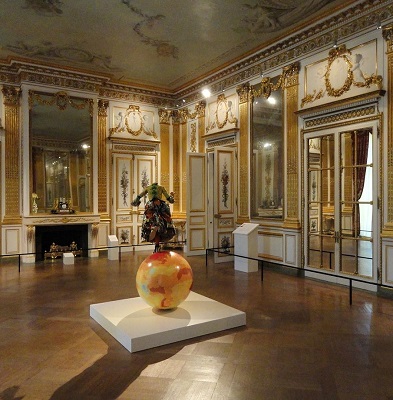
Salon Doré: The Gilded Chamber
Salon Doré - Corcoran Gallery of Art
If walls could talk, few would have as much to say as those of the illustrious, well-traveled, and mysterious Salon Doré. Designed by Jean-Baptiste Alexandre LeBlond between 1708 and 1714 as the bedchamber of the Hotel de Clermont, a private residence in the old aristocratic quarter of Paris, the renowned room (which measures 42 by 23 feet) has survived nearly three centuries and various incarnations. In 1769, the Comte d’Orsay transformed it into a salle de compagnie in which to entertain his noble friends. Four years later he commissioned Hughes Taraval to make a mural for its adjoining dining and gaming room and ceiling. In 1789, the French Revolution interceded, forcing the count to flee to Vienna, where he died a pauper.
The building which contained the Salon Doré became a symbol of imperial decadence, and over the years mysteriously changed hands several times. The room’s extraction from the building is perhaps he biggest mystery of all. The chambre eventually made its way to the U.S. after William Clark of Montana, a well-traveled industrialist-turned-US. senator, bought it and installed it around 1904 in his new mansion on New York’s Fifth Avenue. With the mansion under construction, Clark agreed to let the Corcoran temporarily exhibit his collection of paintings, sculpture, rugs, tapestries, lace, antique furniture, and other valuables. He eventually replaced the collectibles in the Salon Doré and other elegant sections of the new home, but ended up willing the collectibles plus the roving room itself to the Corcoran. After his death, the museum erected a separate wing to house them. The Clark wing, including the Salon Doré, opened to the pubic in 1928.
The Corcoran eventually spent two years and about a million dollars restoring the room to its original site. Today, flower-bearing angels and allegorical figures that depict the seasons and the arts look down with approval on the majestic 17-foot chamber. Light, reflected in five oversized mirror boiserie, intricately carved wood in gold leaf offset against a background of brilliant white. The room includes six trophy panels representing music, love, art, science, victory, theater and sports (the later two added by Clark) which blend perceptibly with gilding that is more than 200 years old.
There are other French period rooms in the US, the J.Paul Getty Museum in California the Philadelphia Museum of Art and the Metropolitan Museum of Art in New York most prominent among them. But the Salon Doré, a three-dimensional expression of the Age of Enlightenment’s philosophy of reason, most closely reflects the experience of the times. Penelope Hunter-Steibel, former curator at the Metropolitan Museum of Art and a specialist in French art, described the Salon Doré as unusual and important because it illustrated French 18th century interior perhaps better than any other room in the country, "the best piece of French interior architecture outside of France," according to Corcoran Director David Levy.